
The popularity of climate action and climate tech seems to have declined in the past few years. Potential causes abound: from “green” activists shifting focus to Middle Eastern geopolitics, through the changing policy and investment landscape in the US, to AI swallowing the attention of techies and non-techies alike. But whatever the causes are, climate change is still happening, with 2026 on track to join 2023, 2024, and 2025 as the hottest years on record.
Since switching my career focus to climate tech in 2022, I’ve had my own ups and downs in my thinking and involvement in the space. With my current positioning, I landed on “helping climate tech founders ship AI/ML solutions that support multi-million dollar growth goals”. However, I remain somewhat uncomfortable with the climate tech framing. The top reasons are: (1) the association with narrow-minded and exclusionary activism; and (2) missing other important aspects of ecosystem resilience.
This post summarises the main trends I’m seeing and outlines a path forward, which may be helpful to others in the space. Personally, I’ll stick with the “climate tech” framing while it remains useful and legible for others, but I now sit more in the “planetary resilience tech” camp.
It’s on the lengthy and exploratory side, so here’s a quick guide based on your interests:
- Climate activism, extremist shifts, and antisemitism
- Climate tech’s definition and its declining trendiness
- Electrotech and resilience tech
- Applying a personal lens to resilience tech
Climate activism and its exclusionary associations
Earlier this year, I attended Climate Action Week in Sydney. In between sessions, I noticed freshly-distributed posters and a protest march forming. What was the protest about? Being the middle of Climate Action Week, you’d think it’d be about climate. Alas, we’re not in 2019 any more. The protest was about the one aspect of Middle Eastern geopolitics that has captured the world’s attention since 2023: Nominally “for Palestine”, it was yet another anti-Israel/anti-Zionist protest.
I found this to be symbolic of what had happened to a segment of the climate movement in recent years: Many climate activists have moved away from advocating for universal causes to allying with sectarian extremists. Examples abound, but one that particularly sticks in my mind is Greta Thunberg chanting “crush Zionism” back in November 2023, as she was formerly the poster child for youth calling for climate action.
Even before 2023, the word climate was already a turn-off for some people due to the politicisation of the underlying science and necessary action. With prominent climate activists and nominally “green” parties turning their attention to anti-Zionism, climate action or “climate justice” has become even more divisive and exclusionary. This is because anti-Zionism that denies Jews their right to self-determination is seen by many as antisemitic, i.e., biased against or hateful of Jews. I subscribe to the view that many of the hardcore activists are behaving antisemitically, as they never call for peace or reaffirm Israel’s right to exist. As an Australian of Israeli-Jewish background, this feels like a more immediate existential threat than climate change, especially after the October 7 and Bondi attacks. But even if you disagree on what counts as antisemitism, you may still agree that there is now a strong association between anti-Zionist activism and climate activism – and that it’s not great for climate. Hence my search for a better term.
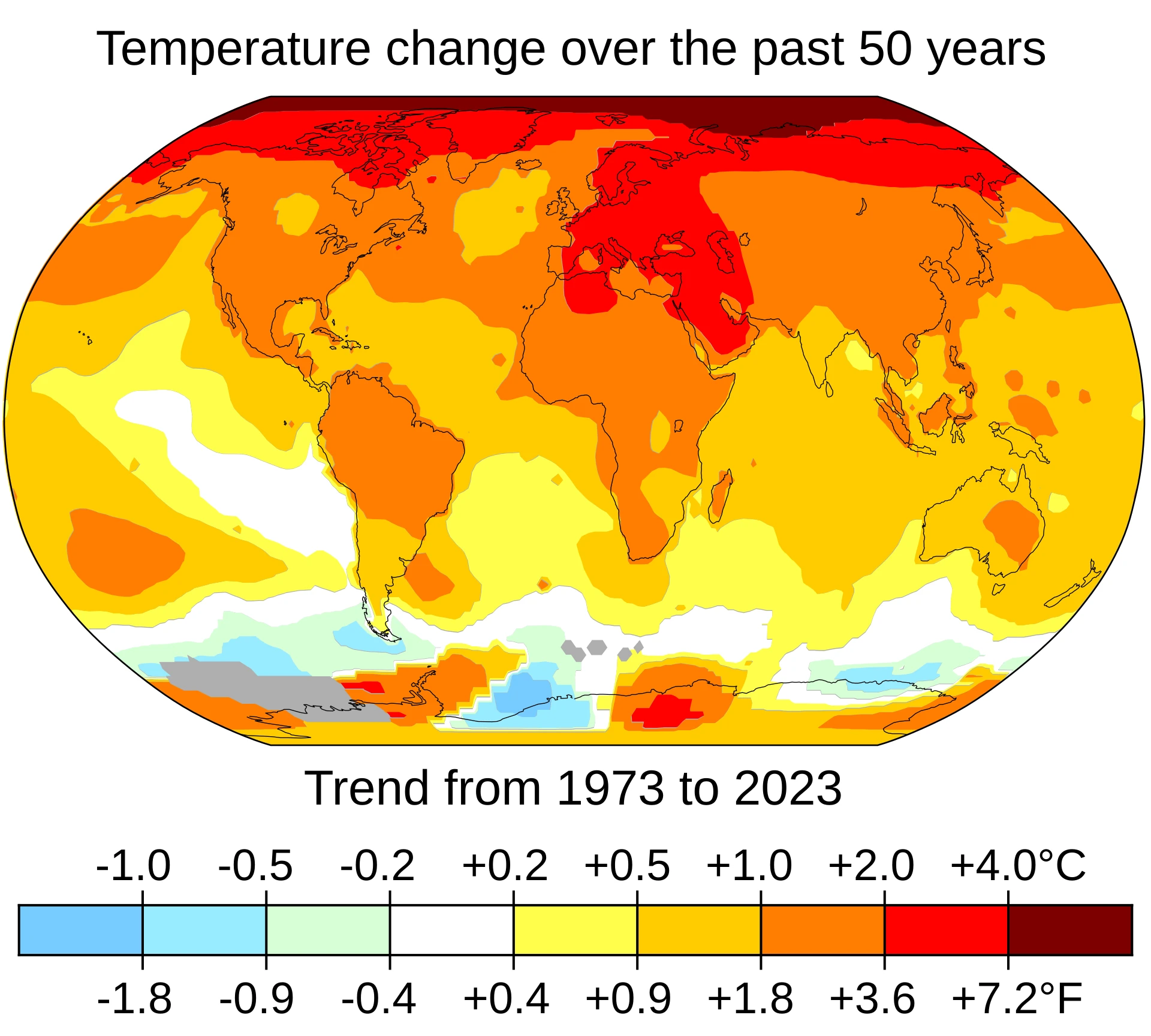
Changes in surface air temperature from 1973 to 2023. Source: Wikipedia.
What is climate tech anyway?
As the figure above shows, climate change is a global issue that transcends geopolitical and ethnic boundaries. That’s partly what jars me about calls for “climate justice” that elevate certain nationalities and ethnicities while excluding others. But that’s what also attracts me to climate tech: Advancing technological solutions that are cheaper and better than the technology that causes climate change side-steps political bickering. This is already happening with tech like rooftop solar, which has record uptake in my home state of Queensland thanks to favourable economics – even by hardcore conservatives who don’t care about climate change.
When it comes to defining climate tech, I still stand behind my thoughts from 2022:
What is climate tech? Good question. To me, defining it is somewhat reminiscent of attempts to define data science, which I’ve tackled in posts from 2014 to 2018. In the same way that data science encompassed things that some people have been doing for decades, climate tech is giving a new name to existing activities. Broadly, I’d say that it’s work on technology to reverse, mitigate, and adapt to anthropogenic climate change.
Another parallel I see between data science and climate tech is that many things with tenuous connections to the field get lumped into it, in an attempt to capitalise on its trendiness. I think we’re past the peak of the data science hype, but there was a time when people who had only taken cursory looks at data rebranded as data scientists. Similarly, there are “climate tech” companies out there that may have a negative or neutral impact on fighting climate change. Personally, I’m also skeptical of grouping adaptation efforts under climate tech. For example, dealing with extreme weather events is needed even in a world with a stable climate, so I don’t think such work captures the intention behind climate tech (though it can be valuable).
One thing that has changed since I wrote those words is the trendiness of climate tech. While solid measures of trendiness are hard to come by, PwC found in 2025 that “climate tech financing dropped 29%, bringing it below pre-2019 levels”. This shift is also captured by a collection of anecdotes, from the My Climate Journey fund, podcast, and community becoming MCJ (with no mention of climate on the homepage), through the SOSV Climate Tech Summit becoming the SOSV Deep Tech Summit (with a one day out of three dedicated to climate tech), to the Work on Climate community changing their focus to “building a regenerative green economy” (but retaining climate in their name – for now).
Trendiness aside, the fuzzy boundary around the inclusion of adaptation has remained a sticking point for me. This is where other, less commonly used, definitions of areas of tech come in handy.
Electrotech and resilience tech
It may be the case that the decline in interest in climate tech is partly a symptom of the sector maturing. Another part of it is undoubtedly related to the shift in US politics since Trump got elected in 2024. For example, in a Sep 2022 letter by the Voyager VC firm, the word climate appears 35 times. Their Jan 2026 letter uses the word climate exactly once, in reference to the 2022 letter. One of the interesting parts of the more recent letter is the introduction of electrotech as a convergence of many of the technologies needed to address climate change (but without using the C-word).
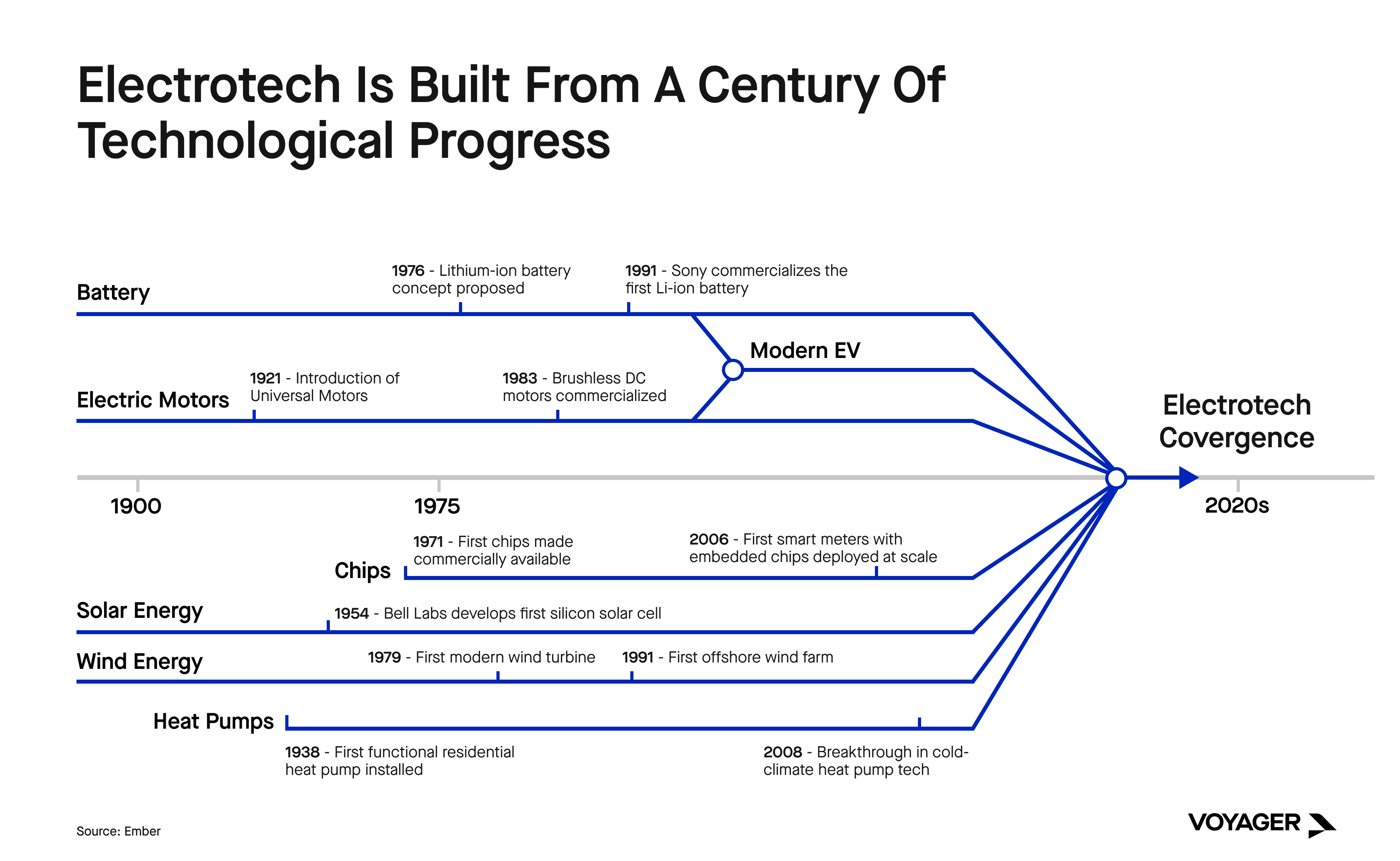
Electrotech’s convergence. Source: Voyager Ventures.
In Voyager’s words:
Over the past five years, electricity has become the dominant way people access energy – surpassing oil, gas, coal, and biomass. The pace of this transition is accelerating, and its largest impacts are still ahead. Technologies that have demonstrated superior economics – a category that includes technologies built on the electrotech stack of batteries, solar and electric vehicles – are winning in global markets, and will continue to win.
From an investor’s perspective, betting on the already-winning and fast-expanding electrotech horse is a compelling proposition. From a climate perspective, electrifying everything and switching to clean electricity sources has long been seen as a big part of the solution. In a world where electrotech becomes increasingly dominant for commercial reasons, climate tech becomes an even less distinct category – and this is a good thing.
While we’re still seeing blips and regressive policies that attempt to prop up legacy fossil fuel industries against the rise of electrotech, the fact is that fossiltech is inferior in many ways that are unrelated to climate. A few examples:
- Electric vehicles don’t emit noxious fumes that lead to excess deaths. They’re also simpler to maintain, faster to accelerate, and their cost is rapidly declining.
- Solar power keeps getting cheaper. Coupled with various storage solutions, the problem of intermittency is getting resolved. There are also solutions in the pipeline to work around the problem of the sun not shining at night by beaming light from space.
- The wars in Ukraine and Iran have demonstrated the volatility of fossil fuel supplies. With electrotech, energy generation and storage are less concentrated geographically, meaning that nations that transition to electrotech are more resilient to future supply shocks.
Zooming out to climate, the energy transition delivered by electrotech remains only a part of the solution. For example, challenges in food systems, land and water use, and manufacturing of steel, cement, and plastics won’t all be resolved by electrotech. But it may be that the success of electrotech signals the path forward: promote adoption based on commercial and self-interested motives, with resilience as a primary imperative. This still works for proponents of climate action, as one could argue that resilience is the main reason behind mitigating and adapting to climate change – and behind the need to choose a more resilient framing for the required work than “climate tech”.
B Capital’s article on resilience tech goes deep into this line of thinking:
Resilience Tech is a refined lens on climate tech, highlighting solutions that strengthen energy, industrial, and infrastructure systems. It includes the tools, infrastructure and platforms that help people, businesses and governments adapt to a changing world—from climate shocks and energy volatility to food insecurity and fragile supply chains. These are the solutions that mitigate systemic risk while creating real economic value and remaining focused on planetary boundaries. Importantly, unlike many traditional climate technologies, Resilience Tech does not depend on incentives or policy mandates. It’s driven by urgent, market-based demand and built to scale on commercial fundamentals. Resilience Tech is underpinned by significant macro trends that we believe will create a ripe landscape for creating generation defining companies over the next decade.
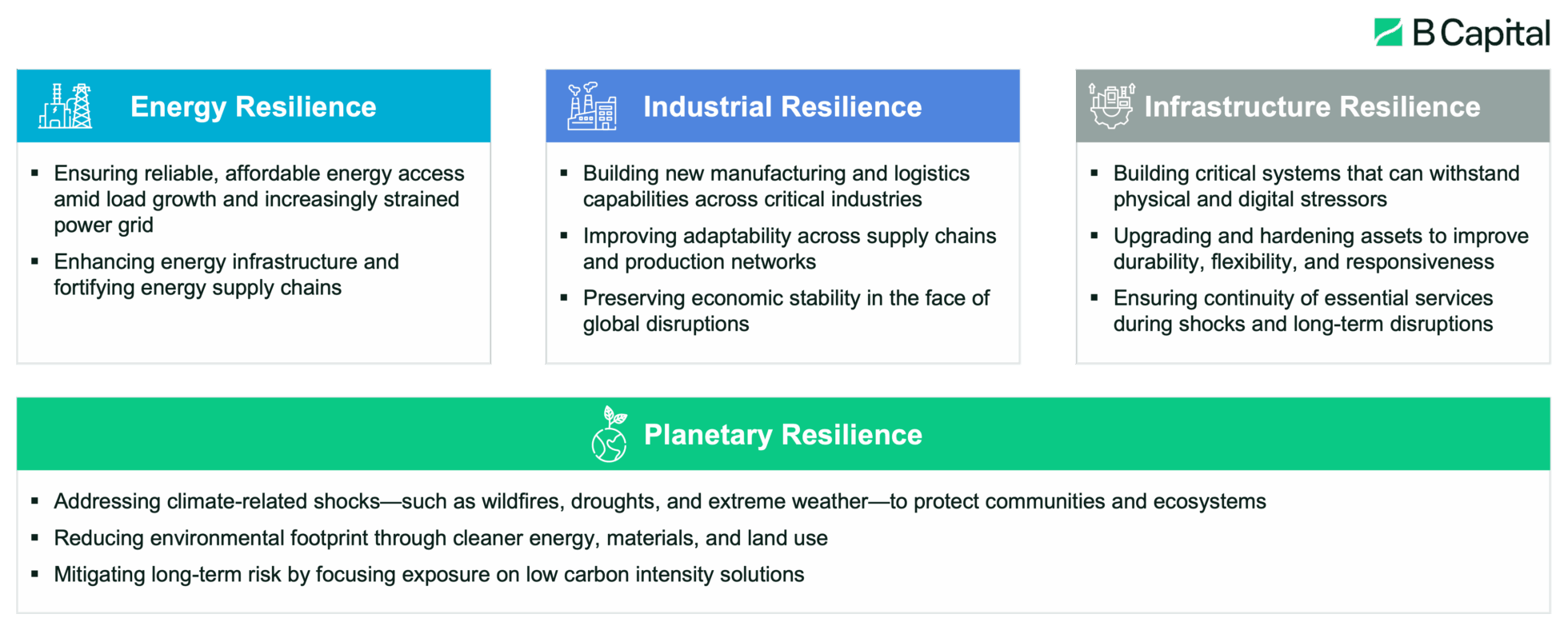
The pillars of resilience tech. Source: B Capital.
While resilience tech is an incredibly broad space, and the title is a bit of a mouthful that may not catch on, I believe B Capital is on to something. Their version of resilience tech captures a key intent that is absent from terms like deep tech or electrotech. But while it’s reasonable to draw inspiration from the likes of B Capital, it’s important to remember that most of us don’t have billions of dollars to deploy – so we need to make narrower bets.
Choosing my own resilience adventure
B Capital frames resilience tech as a refined lens on climate tech, and categorises activities by sector. I find it helpful to also think of resilience more broadly, as multi-level focus areas:
- Individual: Focus on health and well-being.
- Community: Focus on communities of different sizes, including nations.
- Civilisation: Focus on human civilisation as a whole.
- Planetary: Focus on remaining within planetary boundaries, of which climate is just one.
There’s nothing wrong per se with focusing on resilience at only one of these levels, but pursuing objectives at one level may conflict with others. For example, a nation may boost its production and use of fossil fuels in the short term because it can access them cheaply, but this is at odds with staying within planetary boundaries. It also comes at a cost to individual health that often exceeds the benefits. Similar dynamics may play out in arms races, where national resilience comes with the risk of ending civilisation as a whole.
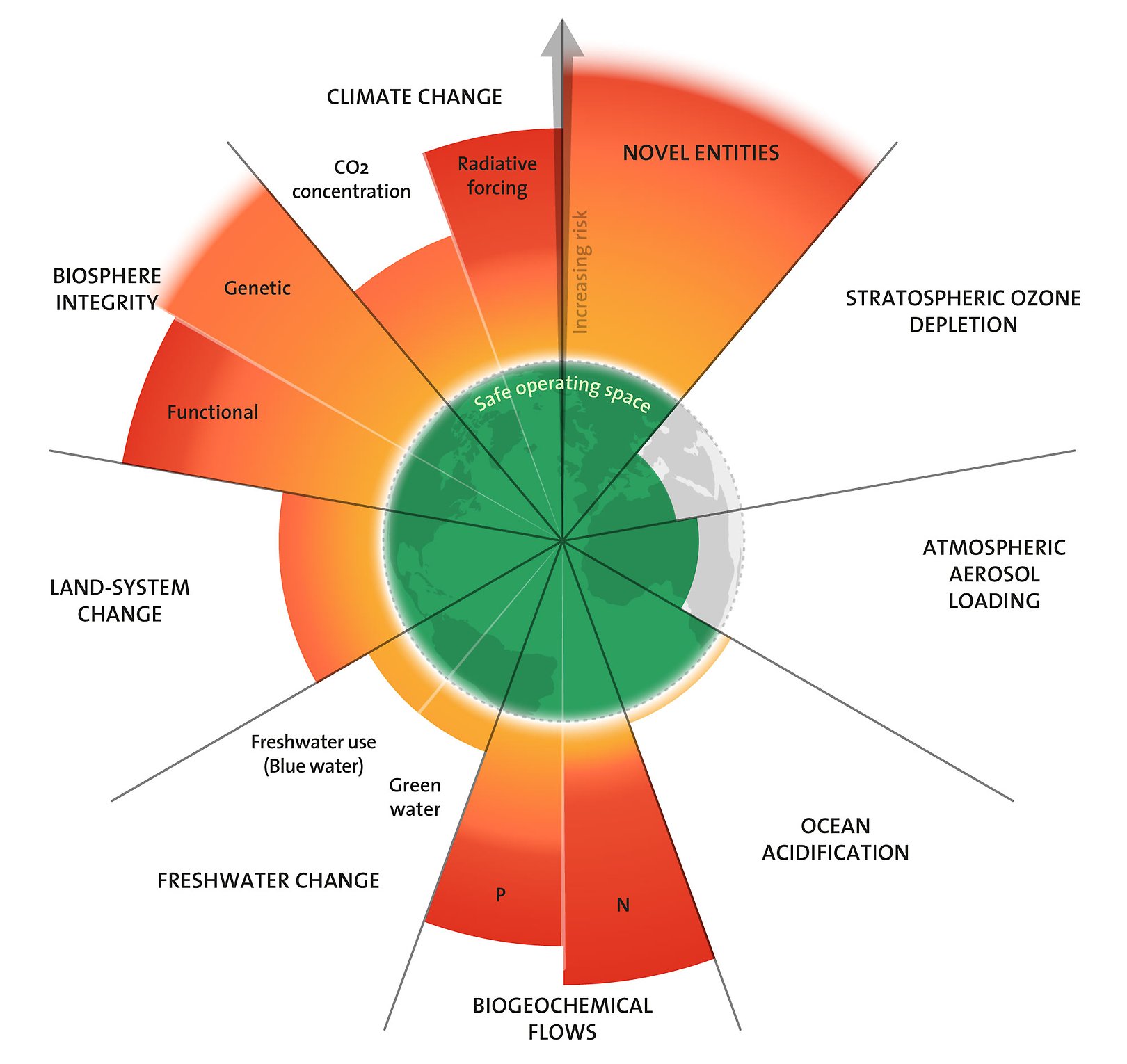
The 2025 update to the planetary boundaries. Source: Stockholm Resilience Centre.
When I published the 2022 post about moving to climate tech, several relevant items were different:
- That was before ChatGPT, the rise of agentic AI, and the automation of many of my technical skills.
- I still considered my profession to be data scientist, despite always working heavily on the engineering side and operating at the architectural and strategic levels.
- Greta and other “greens” have not yet turned significant attention to anti-Zionist activism.
- Climate action and climate tech were still trendy.
- I was content with being an employee of a single climate tech startup.
I’ve addressed the first two points by rebranding as an AI/ML Success Architect – focusing more on what the AIs can’t do yet. Points 3 & 4 would matter little if it wasn’t for Point 5: my shift from salaried employment to independent consulting.
As an employee with one company, industry classification matters little – you either like what the company is doing or you don’t. As an independent consultant, industry specialisation can make a massive difference to finding and attracting the right clients. Even though specialising by industry isn’t the only option, I have little interest in being an AI/ML Success Architect who serves anyone who could pay me.
The people I most want to support are pragmatic builders of planetary resilience tech: not activists or those who are building tech only for the sake of interest or profit. That’s where I and other individuals can (and should) get pickier than investors. Individual time is a precious finite resource that can’t be allocated like capital. Therefore, I aim to spend my limited work time with founders and backers of tech companies that are building towards a positive impact on planetary resilience, and ideally a positive impact on other levels of resilience. However, commercial realities mean that I could make compromises by working on resilience-neutral projects (which arguably comprise most of tech), while still actively avoiding the resilience-negative companies of the world.
That said, I’m not in a mad rush to drop the climate label, as it’s still a useful shorthand that’s commonly used. Despite my alienation from the activist crowd, the reality is that professional activists are rare in climate tech circles due to the associations with capitalism and focus on building commercial technologies within the existing systems. Combining my technical speciality with my values and the shifting tech landscape, I see exciting opportunities with hardware startups in the resilience tech space, where AI/ML adds value to the core hardware offering. More broadly, I’ve come to think of it as placing ecosystem bets – creating planetary resilience tech for our shared future. The titles and brands under which those bets appear are secondary to the impact.
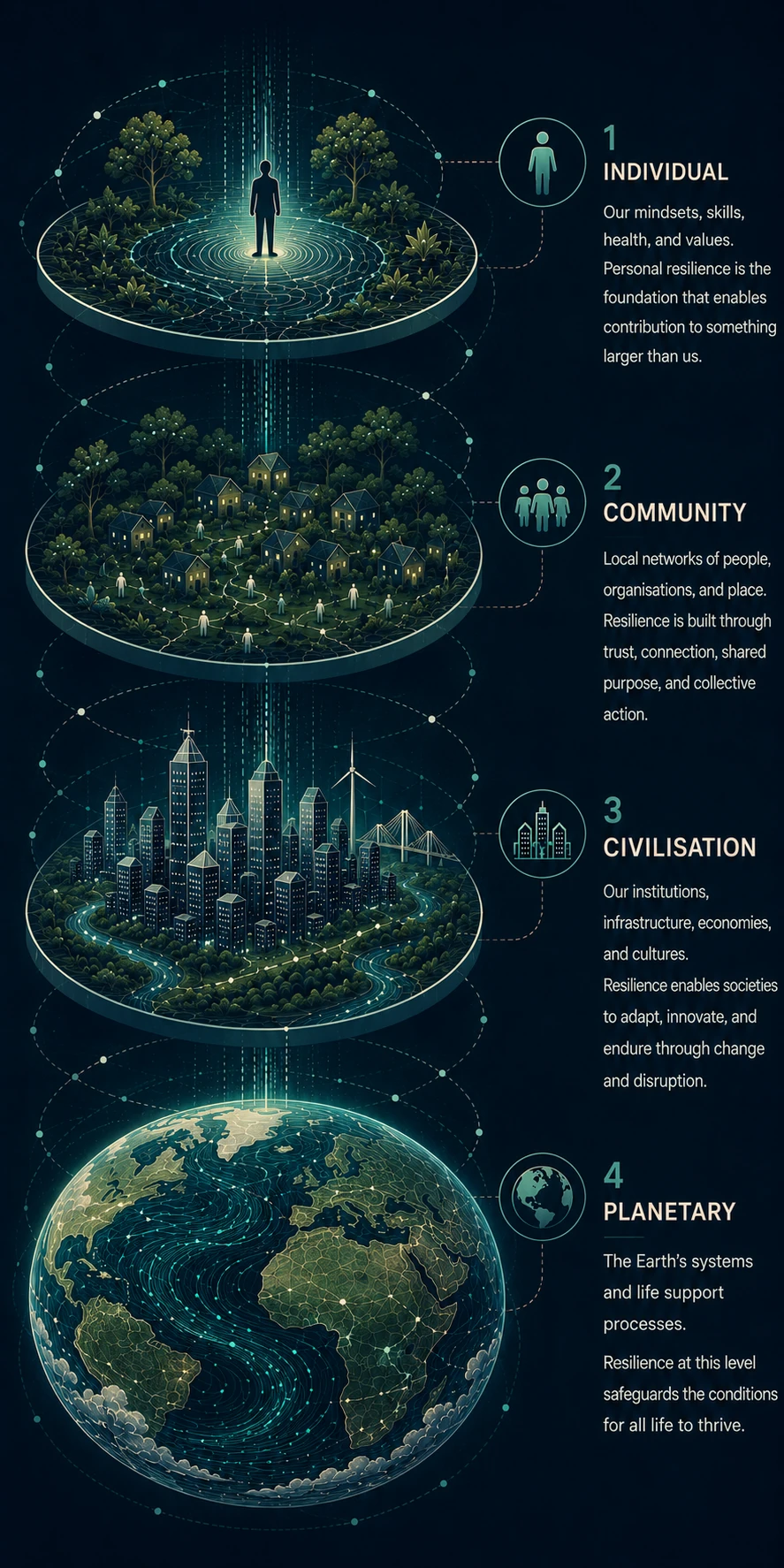
The four levels of resilience. Generated by ChatGPT based on this post.
Public comments are closed, but I love hearing from readers. Feel free to contact me with your thoughts.